
Virtual Horse Racing: Cards, Live Results and Betting Guide UK
Top-Rated Virtual Platform

Top Virtual Races

Gates of Olympus

Sweet Bonanza

Book of Dead

Big Bass Bonanza

Reactoonz

Wolf Gold

Starburst
Gonzo’s Quest

Jammin’ Jars

Buffalo Blitz
Top Games

Big Bass Amazon Xtreme
Cursed Seas

Blood Suckers

Book of 99

Esqueleto Explosivo

Jungle Spirit Megaways

Reactoonz

Rise of Olympus

Big Bad Wolf
Top UK Virtual Horse Racing

- Dedicated Virtual Horse Racing section
- Free bets credited after qualifying wager
- Offers a range of other virtual sports
- Fast withdrawals with popular UK methods
- Focus on UK-friendly virtual horse racing
- Live race simulations with expert commentary
- Low minimum deposit options
- Easy-to-use platform and 24/7 support
- Premier virtual horse racing in the UK
- Features major UK racecourse simulations
- Offers detailed statistics and form guides
- Trusted brand with UKGC licensing
Get Your Welcome to the Races 🏇
Sign up now at Virtual Horse Racing to snag an exclusive United Kingdom welcome package of up to £300 deposit match + 50 Free Spins!
- Claim in Minutes: Bonus funds and spins credited fast.
- Wager Smart: 35x bonus, low 5x wager on spins.
Demo casino

Udostępnij sieci neuronowej
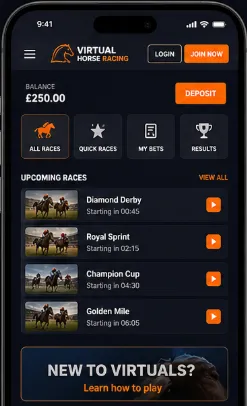
Photos taken with a mobile phone

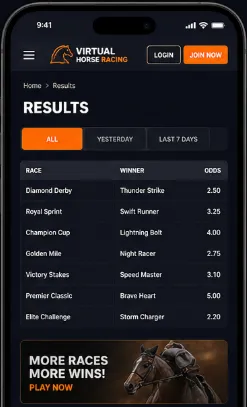
Photos taken with a computer

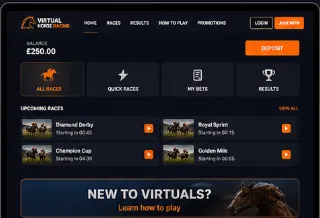
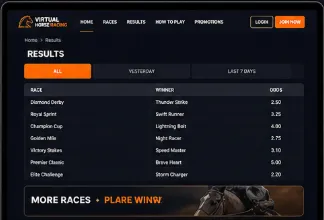
What is virtual horse racing and how does it work?
Virtual horse racing is a computer‑generated, fixed‑odds betting product that simulates horse races on a rapid, repeating schedule. Outcomes are produced by a certified random number generator (RNG) and a probability model created by the content supplier. Bookmakers display prices (odds) for each runner and settle bets exactly as they would for a real race. In the UK, virtual racing is offered by licensed operators under Gambling Commission rules for fairness and transparency, with RNGs tested by accredited laboratories. For regulatory guidance, see the UK Gambling Commission at gamblingcommission.gov.uk.
What determines outcomes: RNG and bookmaker pricing?
Every virtual race result is determined before the animation plays, using an RNG that maps to pre‑assigned probabilities for each runner. The animation, commentary and “form” graphics are presentation layers and do not influence the draw. Bookmakers (or the feed provider) convert those probabilities into fixed odds and include an overround (margin). Bets are then settled to the displayed odds, independent of how much money has been staked on each runner.
- RNG and probabilities: Each runner is assigned a win probability for that race; the RNG selects the outcome according to this distribution.
- Independence: Races are independent events; past results or “streaks” do not change future probabilities.
- Pricing: Displayed odds are derived from the internal probabilities plus a margin (overround). The favourite will generally have the highest win probability and the shortest price.
- Certification and compliance: Reputable suppliers submit their RNGs and games to accredited test labs and operate with UK‑licensed partners; see the UK Gambling Commission at gamblingcommission.gov.uk.
| Runner | Internal win probability | Fair decimal odds (1/p) | With 10% overround: displayed odds example |
|---|---|---|---|
| Favourite | 0.40 | 2.50 | 2.27 |
| 2nd Favourite | 0.30 | 3.33 | 3.03 |
| 3rd Favourite | 0.20 | 5.00 | 4.55 |
| Outsider | 0.10 | 10.00 | 9.09 |
Note: The “displayed odds” column illustrates how an overround can be applied by scaling probabilities so their sum exceeds 100% (here 110%), then converting back to decimal odds. Exact margins and prices vary by supplier and operator.
Who provides UK virtuals: 49s, Inspired, others?
The UK market features established suppliers that create the virtual racing content and probability models, while licensed bookmakers distribute these feeds online and in betting shops. Key names include Inspired Entertainment and the 49’s brand operated within the SIS (Sports Information Services) group, which also supplies and broadcasts betting content to UK operators.
| Provider/Brand | Primary role in the UK | Notable virtual racing products | More info |
|---|---|---|---|
| Inspired Entertainment | Major virtual sports content supplier to UK online and retail operators | Virtual Horse Racing; The Virtual Grand National (media simulcast product) | inseinc.com |
| 49’s (49s) | UK betting brand offering scheduled virtual racing and results (well known in LBOs and online) | Virtual horse racing schedules and results, including named tracks used widely by UK bookmakers | 49s.co.uk |
| SIS (Sports Information Services) | Content and distribution partner to bookmakers; operates the 49’s brand | Broadcast and data services for betting content; virtuals offered via SIS solutions | sis.tv |
UK bookmakers such as ladbrokes.com carry these virtual racing feeds on their websites and in shops, publishing “cards” for upcoming races and quick‑turnaround results for settling.
What are Sprintvalley, Steepledowns and Portman Park?
Sprintvalley, Steepledowns and Portman Park are fictional, UK‑themed virtual racecourses used by leading virtual racing providers. They are not real‑world tracks; instead, they serve as distinct formats to vary race types and presentation. The names are widely used across UK bookmakers’ virtual channels, and results are published by provider and operator portals.
- Sprintvalley: A short‑distance, flat “sprint” format designed for quick races and rapid results.
- Steepledowns: A jumps (steeplechase) format featuring fences, delivering National Hunt‑style contests.
- Portman Park: A flat‑racing format styled on UK turf/all‑weather meetings.
| Virtual track | Discipline/Style | Typical scheduling | Where to see cards/results |
|---|---|---|---|
| Sprintvalley | Flat sprint | High‑frequency events (often every 1–3 minutes, operator‑dependent) | 49s.co.uk, ladbrokes.com |
| Steepledowns | Jumps (steeplechase) simulation | High‑frequency events (often every 1–3 minutes, operator‑dependent) | 49s.co.uk, ladbrokes.com |
| Portman Park | Flat racing simulation | High‑frequency events (often every 1–3 minutes, operator‑dependent) | 49s.co.uk, ladbrokes.com |
Availability, schedules and on‑screen branding can vary by bookmaker, but the core proposition is consistent: frequent, RNG‑driven races with clear cards and fast results to support fixed‑odds betting.
Where can I find today’s cards and live results in the UK?
In the UK, today’s virtual horse racing cards and live results are published by licensed bookmakers and by official content brands that supply the virtual feeds. If you are in London or anywhere in Britain, the fastest sources are your bookmaker’s website/app (for online viewing and betting) and in‑shop screens at licensed betting offices. Provider sites also carry schedules and results for named virtual tracks such as Sprintvalley and Steepledowns.
How do you read today’s virtual racing cards?
Virtual racing cards mirror real‑world racecards but are designed for rapid, repeat events. Understanding each field helps you place the correct bet and confirm settlement rules before the race countdown reaches zero.
Track and race: The header shows the fictional track (e.g., Sprintvalley, Steepledowns, Portman Park), race number, and a countdown or off‑time.
Discipline and distance: Flat sprint or jumps simulation is indicated; distance/format helps you recognise track types at a glance.
Runners and numbers: Each runner has a saddlecloth number, name, and silks. The number is used to identify your selection on the slip.
Odds: Prices are typically shown in fractional format for UK bettors (e.g., 3/1), with decimal available on some sites. Odds are fixed and set by the operator’s feed.
Markets: Common options include Win and Place; many operators also offer Forecast (exacta) and Tricast (trifecta). Each‑Way availability varies by bookmaker.
Indicators: Look for icons or labels such as “stream” (video available), “result pending,” or “photo” for close finishes.
Settlement cues: Cards often show how and when bets settle (immediately after result confirmation). Any special rules will be listed in the market info panel.
Select the track and upcoming race from the schedule (check the countdown).
Review runner numbers, names, and the displayed odds; confirm market (Win/Place/Forecast/Tricast).
Enter your stake and submit before the cut‑off. Keep the receipt/reference to reconcile the result after settlement.
Where to get live results today for Sprintvalley and Steepledowns?
Live results for Sprintvalley and Steepledowns are posted moments after each virtual race finishes. The most reliable sources are the provider’s official portal and your bookmaker’s results page or in‑shop screens. Streaming (when available) is typically restricted to logged‑in or age‑verified customers, but textual results for settlement are displayed openly by operators.
| Source | Access | Coverage of Sprintvalley/Steepledowns | Cost | Notes |
|---|---|---|---|---|
| 49’s (official provider brand) | 49s.co.uk | Yes, publishes virtual racing schedules and results for named tracks used by UK bookmakers | Free to view | Text results appear shortly after each race; presentation and depth may vary by schedule |
| Ladbrokes (UK bookmaker) | ladbrokes.com | Yes, when those tracks are on the operator’s current virtual schedule | Free results; streaming may require an account | Shows race cards, countdowns, and posts results promptly for settlement |
| Licensed betting shops (LBOs) | In‑shop TV screens and bet terminals | Yes, aligned to the shop’s subscribed virtual feed | Free to view in‑store | Results cycle continuously; staff can help locate the latest Sprintvalley/Steepledowns races |
Tip: If you are reconciling multiple bets in quick succession, note the race number and off‑time alongside the track name. This makes it easy to match your receipt with the live result feed and your bet history.
Can you view yesterday’s results and archives?
Yes. Most provider and bookmaker portals maintain recent virtual racing results so you can check yesterday’s outcomes and reconcile settled bets. On provider sites, use the track selector (e.g., Sprintvalley or Steepledowns) and a date filter if offered. On bookmaker sites, look for a “Results” or “History” tab; your account’s bet history will also list settled markets with timestamps. Archive depth varies by operator and may change, so if you need a record for longer periods, save or export results and keep your bet confirmations. For official track lists and current schedules, consult the provider at 49s.co.uk, and for operator‑specific postings use your bookmaker’s portal, such as ladbrokes.com.
Which bets pay best and how do you stake on 1‑minute races?
Virtual horse racing uses fixed‑odds markets presented on a rapid, repeating schedule. “Best” payout depends on your objective: Win and Place offer frequent, smaller returns; Forecast and Tricast can return more but land less often and require multiple selections or lines. Always check the operator’s rules for each market and remember that outcomes are determined by an RNG. For fairness and consumer guidance, see the UK Gambling Commission at gamblingcommission.gov.uk and safer gambling resources at begambleaware.org.
What do win, place, forecast and tricast bets pay?
All returns are determined by the odds and settlement rules posted by your bookmaker. Win and Place settle to the displayed fixed odds. Forecast and Tricast are settled using operator‑calculated returns based on the underlying prices and finishing order (not a pari‑mutuel pool). Combination versions multiply the number of lines and total stake.
| Market | Pick requirement | Lines / stake structure | Settlement basis | Return rule (summary) |
|---|---|---|---|---|
| Win | 1 runner to finish 1st | 1 line (single) | Fixed odds displayed by the operator | Fractional: stake × (num/den) + stake. Decimal: stake × price |
| Place | 1 runner to finish in a place position (as defined by operator) | 1 line (single) | Either separate Place odds or each operator’s stated place terms | Pays per displayed Place odds or per stated place terms (check market info) |
| Straight Forecast | Pick 1st and 2nd in the correct order | 1 line | Operator’s computer‑calculated forecast return | Paid to the operator’s published figure for that exact order |
| Reverse Forecast | Two runners to finish 1st/2nd in any order | 2 lines (covers both orders) | As above, per line | Both lines settle separately; total return is the sum of any winning line(s) |
| Straight Tricast | Pick 1st, 2nd, 3rd in the correct order | 1 line | Operator’s computer‑calculated tricast return | Paid to the operator’s published figure for that exact order |
| Combination Tricast (3 selections) | Three named runners to fill 1st–3rd in any order | 6 lines (3! permutations) | As above, per permutation | Each winning permutation pays; total return is the sum of winning lines |
Worked example (fractional odds, illustrative math): A £5 Win at 3/1 returns £20 (£15 profit + £5 stake). A £2 Reverse Forecast is two £1 lines; if one line wins at a published forecast figure of, say, 18.00 (decimal) for that order, the return is £18 on that winning line. Exact figures always come from the operator’s live market at settlement.
What bankroll rules work for rapid cycles?
Because virtual races can occur every 1–3 minutes, bankroll management is essential to avoid staking too much, too fast. Use fixed rules that cap exposure per race and per session, and avoid progression systems that amplify losses under time pressure.
- Define a session budget (e.g., an amount you are prepared to lose) and a hard stop‑loss (e.g., 30–50% of the session budget).
- Use small, consistent stakes: 0.5%–1% of bankroll per race for Win/Place; cap at 0.25%–0.5% per line for Forecast/Tricast due to variance.
- Limit total lines: for combinations (e.g., Reverse Forecast, Combination Tricast), pre‑set a maximum total stake per race to prevent over‑exposure.
- Set a stop‑win (e.g., 20%–30% of session budget) and end the session when hit to lock in gains.
- Avoid chasing losses or doubling stakes; virtual results are independent RNG draws.
- Schedule breaks (e.g., 10 minutes off every 30 minutes) to reduce impulsive staking in 1‑minute cycles.
- Track outcomes: log race number, market, stake, and return; review hit rates and average return per line.
- If you model edge‑based staking (e.g., Kelly), use a small fraction (≤ 0.25 Kelly) and only with verifiable edge; in virtuals, a reliable edge is unlikely.
- Use operator tools: deposit limits, reality checks, and time‑outs; see begambleaware.org for support.
Does form matter in virtuals or is it cosmetic?
In virtual racing, the on‑screen “form,” silks, names and commentary are presentation layers. The outcome is decided by a certified RNG against internal probabilities for that race; graphics do not influence the draw. Providers often align the favourite’s displayed “form” with its shorter price to make the presentation feel realistic, but previous virtual results or displayed form do not change the next race’s probabilities. For fairness requirements, see the UK Gambling Commission at gamblingcommission.gov.uk.
- Matters: the actual odds, market type, number of lines you’re staking, and the operator’s settlement rules.
- Mostly cosmetic: runner “form,” trainer/jockey styling, and broadcast commentary (they do not affect the RNG outcome).
- Practical takeaway: treat virtual cards like fixed‑odds games—price and staking discipline drive results, not narrative form.
Is virtual horse racing fair or “rigged”?
In the UK, virtual horse racing offered by licensed operators is regulated under the Gambling Act 2005 and the UK Gambling Commission’s Remote Technical Standards (RTS). Outcomes are generated by tested random number generators (RNGs) and mapped to predefined probabilities; the video is a visualisation only. Licensed operators must ensure randomness, independence between events, and transparent settlement rules. You can read the RTS on the UK Gambling Commission website at gamblingcommission.gov.uk/standards/remote-technical-standards and verify operators on the Public Register at gamblingcommission.gov.uk/public-register.
How does randomness ensure independent races?
Each race result is produced by an RNG that has been statistically tested by accredited laboratories to meet standards for unpredictability and lack of bias. The RNG output is converted into a race outcome according to the provider’s probability model for that event, and the result is fixed before the animation plays. Because the RNG draw for each race is a separate event, previous outcomes do not affect the next one—the races are independent. Operator margins are applied in the pricing, but the margin does not change the random selection of the winner.
- RNG integrity: RNGs used in licensed products are tested for distribution quality, serial correlation, and long‑run balance as required by the UKGC RTS.
- Pre‑determined settlement: The winning order is computed before the video; graphics, commentary, and “photo finishes” do not alter the result.
- Event independence: Each race uses a fresh RNG call; there is no “hot” or “cold” streak effect.
- Auditability: Providers log outcomes and versioned math models; operators retain records for dispute resolution and regulatory audits.
- Standards: See the UKGC RTS at gamblingcommission.gov.uk/standards/remote-technical-standards.
What are the signs of a responsible UK operator?
Responsible operators make licensing, rules, and safer‑gambling tools easy to find, and they use independently tested content. A quick check of licensing details against the UKGC Public Register, plus the availability of self‑exclusion and dispute pathways, helps you confirm you are betting with a compliant UK site or shop.
| Checklist item | What to look for | Where to verify |
|---|---|---|
| UK licence disclosure | “Licensed and regulated by the Gambling Commission” with a link to the licence record | UKGC Public Register |
| Technical compliance | Statements that RNG‑based products comply with UKGC Remote Technical Standards | UKGC RTS |
| Safer gambling tools | Deposit limits, time‑outs, reality checks, and links to support | BeGambleAware, GAMSTOP |
| ADR availability | Clear escalation route to an Alternative Dispute Resolution (ADR) provider | IBAS (ADR) |
| Transparent rules | Published settlement rules for Win, Place, Forecast, and Tricast; odds format and cut‑off times | Operator’s Terms and Rules pages |
If an operator lacks a visible UK licence, does not provide safer‑gambling tools, or refuses to signpost an ADR scheme, treat this as a red flag and verify the brand on the UKGC Public Register at gamblingcommission.gov.uk/public-register.
Virtual vs real racing: which is better for bettors?
“Better” depends on your goals. Virtuals deliver constant availability, fast settlement, and fixed odds—but because results are RNG‑driven and independent, there is no reliable form edge to exploit, and the operator’s margin is embedded in every price. Real‑world racing introduces uncertainty from horse fitness, going, trainer strategies, and market movements; skilled analysis can sometimes find value, but it remains a negative‑expectation activity on average once the bookmaker margin or pool takeout is considered.
- Virtual racing advantages: immediate action (often every 1–3 minutes), known fixed odds, no weather or non‑runner complications, rapid settlement.
- Virtual racing limitations: no informational edge beyond price shopping; long‑run expectation is negative due to the margin.
- Real racing advantages: potential to apply data and judgment (form, pace, going, sectional times, trainer patterns) for occasional value.
- Real racing limitations: slower cadence, non‑runners/Rule 4 deductions, higher research time, market volatility.
- Practical takeaway: choose the format that fits your time and risk tolerance, set strict staking limits, and use safer‑gambling tools such as GAMSTOP and resources at BeGambleAware.
From shop screens to 24/7 sprints: how did we get here?
Virtual horse racing in the UK evolved from scheduled shop broadcasts to always‑on, high‑frequency products integrated across retail, web and mobile. Early systems mirrored TV‑style programming on betting shop screens; today’s versions run every one to three minutes with consistent branding (e.g., Sprintvalley, Steepledowns) and fixed‑odds settlement. Improvements in random number generation (RNG), graphics, distribution networks and user interfaces have driven the shift to rapid, continuously available betting cycles.
How did early video lotteries and fixed schedules work?
Early virtual racing arrived in UK licensed betting offices (LBOs) as scheduled “channels” inserted between live sport. Providers generated the outcomes using RNGs, created a pre‑rendered race animation, and distributed the feed to shops on a fixed timetable so staff and customers could follow a predictable cycle.
- Broadcast cadence: Races were slotted every few minutes (often 3–5) on a repeating loop so punters could join, bet, watch and settle in sequence.
- Distribution: Content was carried over the same satellite/terrestrial networks that LBOs used for live pictures; Sports Information Services (SIS), founded in 1986, underpinned much of the in‑shop broadcast infrastructure.
- Terminals and slips: Early interactions were via printed coupons or shop terminals; selection was by runner number and market (Win/Place/Forecast/Tricast).
- Settlement: Results were determined before the animation played and posted on‑screen; staff reconciled slips against the race number and time.
| Period | Channel/Tech | Operational feature | Impact on bettors |
|---|---|---|---|
| Late 1990s–early 2000s | Shop broadcast loops + RNG outcomes | Fixed race slots; pre‑rendered animations | Predictable schedule; simple bet types and quick settlement |
| Mid‑2000s | Wider LBO rollout; improved graphics | More frequent races; clearer on‑screen cards | Higher engagement; easier identification of runners/odds |
| 2010s | Online/mobile integration | In‑account betting, streaming and results | Anytime access; faster bet placement and history tracking |
| 2017 onward | High‑profile media simulcasts | Virtual Grand National broadcasts using provider tech | Mainstream visibility; broader acceptance of virtual formats |
As connectivity improved, the same core model—RNG outcomes mapped to probabilities—migrated from shop screens to web and mobile, preserving the fixed‑odds settlement punters were used to in LBOs while adding account tools and bet history.
Which formats failed and why did others survive?
Virtual formats that survived share three traits: high cadence, simple markets, and frictionless access. Concepts that slowed the cycle, complicated staking, or created confusion tended to fall away in favour of fast, clear, and repeatable experiences.
- Didn’t last: Long, commentary‑heavy races that reduced event frequency and delayed settlement; punters preferred more turns per session.
- Didn’t last: Overly complex bet menus and multi‑step coupons that increased user error and queue times in shops.
- Didn’t last: Low‑quality video or unreliable display timings that broke trust in the schedule and settlement.
- Endured: Short “sprint” formats (e.g., Sprintvalley) and simple jumps simulations (e.g., Steepledowns) with clear countdowns and result posts.
- Endured: Fixed‑odds markets (Win/Place/Forecast/Tricast) that mirror familiar real‑racing bets.
- Endured: Consistent branding across retail and online, making it easy to recognise tracks and reconcile results.
What’s next: mobile, on‑demand and party events?
The next phase focuses on personalisation, immediacy and context‑specific experiences. Mobile delivery already dominates usage, and providers are extending on‑demand variants where a race can start when the user is ready. Outside gambling venues, party or hospitality settings increasingly use virtual racing for entertainment; when no real‑money betting occurs, these operate as amusement experiences, while any real‑money betting must follow UK licensing rules.
- Mobile‑first UX: Faster load times, vertical video, and tappable cards streamline selection and stake entry on small screens.
- On‑demand modes: Instant‑start races let users avoid waiting for a global schedule while preserving fixed‑odds settlement rules.
- Personalisation: Remembered preferences (odds format, stake presets) and clearer bet receipts improve reconciliation for rapid cycles.
- Party and hospitality use: Play‑money or prize‑draw formats for events; any cash betting requires compliance with UK gambling regulation.
- Data transparency: Clearer on‑screen labelling of market type, race number and settlement state to reduce disputes in high‑frequency play.
Frequently Asked Questions
Are virtual horse racing winnings taxed in the UK?
For UK residents, gambling winnings are not subject to Income Tax; the tax burden sits with licensed operators. HMRC taxes operators via UK gambling duties that apply to the specific product, while customers receive winnings as 0% taxable income. Operators pay UK gambling duties set by HMRC that can differ by product type and can change over time, but this does not alter the customer outcome; you do not file tax returns on virtual racing winnings and losses cannot be offset against income tax.
What is the house edge (overround) on UK virtual horse racing and how do I estimate RTP?
The bookmaker margin is embedded in prices via the overround; a typical virtual racing overround is about 108%–120%, implying a theoretical payout (RTP) of roughly 83%–93%. Add 1/decimal-odds for every runner to get the overround, then compute RTP as 1 divided by that sum, for example a 112% book equates to RTP ≈ 1/1.12 = 89.3% and a 10.7% expected loss per unit staked in the long run.
Do different UK bookmakers show different odds for the same virtual race?
Yes, displayed odds and total overround can vary by operator even when the animation looks identical. A favourite priced at 2.25 with one bookmaker and 2.30 with another is a 2.2% improvement in the offered return, and across a full field the total book might differ by several percentage points, for example 110% versus 114%, which compounds over many bets.
Are UK virtual horse races truly 24/7 and how often do they run?
Most operators schedule virtual races around the clock with short maintenance windows, and races typically run every 1–3 minutes. On-demand modes can start within about 1 second of selection, while scheduled channels commonly cycle 20–30 events per hour per track so multiple tracks together can exceed 60 betting opportunities per hour.
How quickly are virtual horse racing results posted and settled?
Results usually appear within 2–10 seconds of the animation ending and bets settle almost immediately after result confirmation. Where streaming latency exists, the back-end result still finalises first; account balances typically reflect settlement within 0–60 seconds, and any rare resettlements are timestamped in the bet history for audit.
What are typical minimum stakes and maximum payouts for UK virtual horse racing?
Online minimum stakes commonly start at £0.10–£0.50 per line, with some retail terminals using £1 as the floor, while maximum payout caps are operator-specific and often sit in the tens to hundreds of thousands of pounds. Always check the site’s max payout table, for example separate caps can apply to Win/Place versus Forecast/Tricast, and combination bets multiply the total stake across lines.
Do UK virtual horse racing markets allow Each-Way betting?
Each-Way is less common in virtuals; most operators offer Win and a separate Place market instead. If Each-Way is offered, the total stake is doubled and the place terms are explicitly stated by the operator, for example number of places and a fraction of the win odds, and a £5 Each-Way becomes a £10 total stake with win and place parts settled independently.
How do dead-heats, voids and photo finishes settle in virtual horse racing?
Photo finishes are presentation only; the RNG-determined result is final, while dead-heats are settled by standard halving rules. For example, a £10 Win at 3/1 in a two-way dead-heat pays as if £5 at 3/1, returning £20, and void races see stakes returned; Forecasts and Tricasts follow the operator’s published computer-calculated returns for the confirmed order only.
Why might two sites show the same virtual race name but different results or times?
Providers run multiple schedules, so operators may carry different channels with the same track names but offset race numbers and times. To match bets and results, always compare three identifiers together: track name, race number, and the off-time; if any differ, you are likely looking at separate schedules and the results will not align.
Can I watch UK virtual horse racing live outside the UK?
Streams are often geo-restricted and require age-verified accounts; many operators limit access to UK and Ireland IPs. Text results are usually accessible globally, but video typically checks both login state and location, and VPN use can trigger blocks or delays; expect streams to be limited where local laws restrict remote gambling.
What is the complaint timeline and ADR process for UK virtual betting disputes?
UK-licensed operators must resolve complaints or issue a deadlock letter within 8 weeks, after which you can escalate to an approved ADR such as IBAS. Keep your bet reference, race number and timestamp; operators log outcomes and settle rules, and ADRs review the logs and ruleset to issue decisions based on the recorded result and market terms.
Who audits UK virtual horse racing RNGs and how often?
Accredited test labs such as eCOGRA, GLI or iTech Labs perform mathematical RNG and game testing before release and when significant updates are made. Labs run distribution and randomness batteries on millions of outcomes, for example chi-square and serial-correlation tests, and issue versioned certificates that operators reference in technical compliance statements.
Do bonuses or free bets work on virtual horse racing?
Many promotions exclude virtuals or apply reduced wagering contribution, often 0%–100% depending on the offer. If allowed, free bet stakes are usually not returned, for example a £5 free bet at 4.0 returns £15, and expiry windows commonly run 3–7 days; always check whether virtuals qualify, what markets are eligible, and the contribution percentage.
Is there a practical way to shop for better value on 1‑minute virtual races?
Yes, compare the total overround and specific runner prices across two or more licensed bookmakers to reduce expected loss. Summing the implied probabilities across a field lets you pick the lower-margin book, for example choosing a 110% book over a 114% book improves theoretical RTP from 90.9% to 87.7% loss avoided per unit stake across many bets, and even a 2.25 versus 2.30 favourite is a 2.2% improvement on that leg.
What KYC rules affect depositing and withdrawing virtual racing winnings in the UK?
Age and identity must be verified before gambling, and withdrawals are processed only after KYC is complete. Processing times vary by operator and method, but typical internal review ranges from instant to 48 hours, followed by payment rails that take about 0–3 working days for cards and faster payments that can land within minutes once released.
Can I run a charity or party night using virtual horse races without a UK gambling licence?
You can use virtual races for entertainment without taking real-money bets, but accepting wagers or paying out winnings requires appropriate UK licensing. Non-commercial events have narrow exemptions that do not cover bookmaking; if money is staked with odds and prizes, treat it as regulated gambling and seek legal guidance or avoid cash betting entirely.
How close to the start can I place a virtual horse racing bet and what if it times out?
Cut-off is typically a few seconds before the off, often 3–5 seconds online and sometimes earlier on retail terminals. If the countdown hits cut-off during placement the system rejects or price-updates the bet, and any accepted ticket shows a timestamp and reference; if a price changes in the final seconds, the site either prompts acceptance or declines according to your settings.
Reviews
I’ve tried a few different virtual-horse-racing UK platforms, but this one has the best-presented races and most realistic graphics. It’s a fun, quick game that doesn’t require a huge deposit to get started. The results feel completely random and fair, which is important.
As a fan of horses, I appreciate the effort put into the visuals for the virtual-horse-racing united kingdom games. It’s a great alternative when there are no live races on. The interface is straightforward, and I’ve had some decent small wins here and there. Definitely worth a spin.
Perfect for a quick gaming session. The virtual-horse-racing games are fast-paced and you get a result every couple of minutes. I like that you can play for small stakes, and the site often has promotions related to these games, which is a nice bonus for UK players.
Offers a solid virtual-horse-racing uk experience. The races are frequent and the betting options are clear. It’s not going to replace the thrill of the real thing, but it’s a fun and convenient way to pass some time, especially on mobile. Could use a few more track variations though.
I was looking for something different from slots and found the virtual-horse-racing united kingdom section. It’s really easy to understand, even for a beginner like me. The races are over quickly, so it doesn’t get boring. A good, lighthearted bit of fun.
Virtual Horse Racing FAQ - Your Ultimate Guide to Betting on Virtual Races
What is Virtual Horse Racing?
Virtual Horse Racing is computer-generated, animated horseracing content designed specifically for betting, simulating real races using advanced algorithms. Events run around the clock, often broadcast as short, quick-fire races, providing a continuous betting opportunity for UK fans. It’s a thrilling and fast-paced alternative to live racing where outcomes are decided by an RNG for fairness.
How does the UK's Virtual Horse Racing work?
Virtual Horse Racing in the UK operates through sophisticated gaming software that creates realistic race simulations from start to finish. Each virtual horse has pre-programmed attributes, influencing its odds, with race results determined by a certified Random Number Generator. You can access these races via licensed UK betting sites, placing bets just like on live events.
Is Virtual Horse Racing a form of gambling?
Yes, Virtual Horse Racing is a form of licensed, regulated sports betting where you wager real money on the outcome of the simulated races. In the UK, it is offered exclusively by operators holding a valid Gambling Commission license to ensure safety and fairness. It’s important to always gamble responsibly and within your means.
Can I get tips for betting on Virtual Horse Racing?
While Virtual Horse Racing relies on unpredictable RNG outcomes, bettors can use strategies like analysing the form and odds displayed for each virtual runner. Popular betting tips include managing your bankroll, diversifying bet types, and tracking race histories where available. Always use reputable UK-facing guides for responsible gambling advice.
What types of bets can I place on Virtual Horse Racing?
You can place classic UK betting options like win, place, each-way, or forecast/trifecta bets on virtual horse racing events. Many UK bookmakers also offer combination bets, such as doubles and accumulators, across multiple virtual races for larger potential payouts. Check the specific rules for each race on your chosen platform.
Is Virtual Horse Racing fair and unbiased?
Yes, legitimate UK operators ensure fairness by using independently tested Random Number Generators to produce random and verifiable outcomes. All licensed virtual horse racing in the United Kingdom adheres strictly to UK Gambling Commission regulations regarding game integrity. You should only play at licensed, UK-facing betting sites that display certificates of fairness.
Can I watch Virtual Horse Racing for free?
Most UK betting platforms broadcast virtual horse races live as a free stream to attract bettors and provide entertainment with no charge. You can often find these races available on bookmakers’ websites or apps without needing to place a bet. Some dedicated virtual sports channels also exist, offering continuous free views of the action.
Are the odds good on Virtual Horse Racing in the UK?
Yes, odds on UK virtual horse racing are competitive and typically reflect the attributes of the virtual runners, giving bettors a clear framework for decision-making. Because virtual events run so frequently, you’ll find many betting opportunities across a range of odds throughout the day. Always compare markets between reputable UK bookmakers for the best value.
Can I play Virtual Horse Racing on my mobile?
Absolutely, virtually all major UK betting sites and apps offer a fully optimised mobile platform or app where you can bet on virtual horse racing. This allows you to enjoy the immersive animations and place bets conveniently from your smartphone or tablet at any time. Ensure you have a stable internet connection for the best experience.
Where can I find reliable Virtual Horse Racing sites in the UK?
The safest way is to choose established online bookmakers licensed and fully regulated by the UK’s Gambling Commission. These reputable UK platforms are subject to strict standards regarding safety, fairness, and responsible gambling. You can also look for trusted, independent affiliate sites specialising in UK virtual horse racing reviews to compare options.

An exclusive bonus awaits you!